How to Read an Olive Oil Label: 9 Lines on a Real Bottle
How to read an olive oil label line by line on a real bottle: cold pressed, product of Italy, best before, lot number, acidity and what was missing.
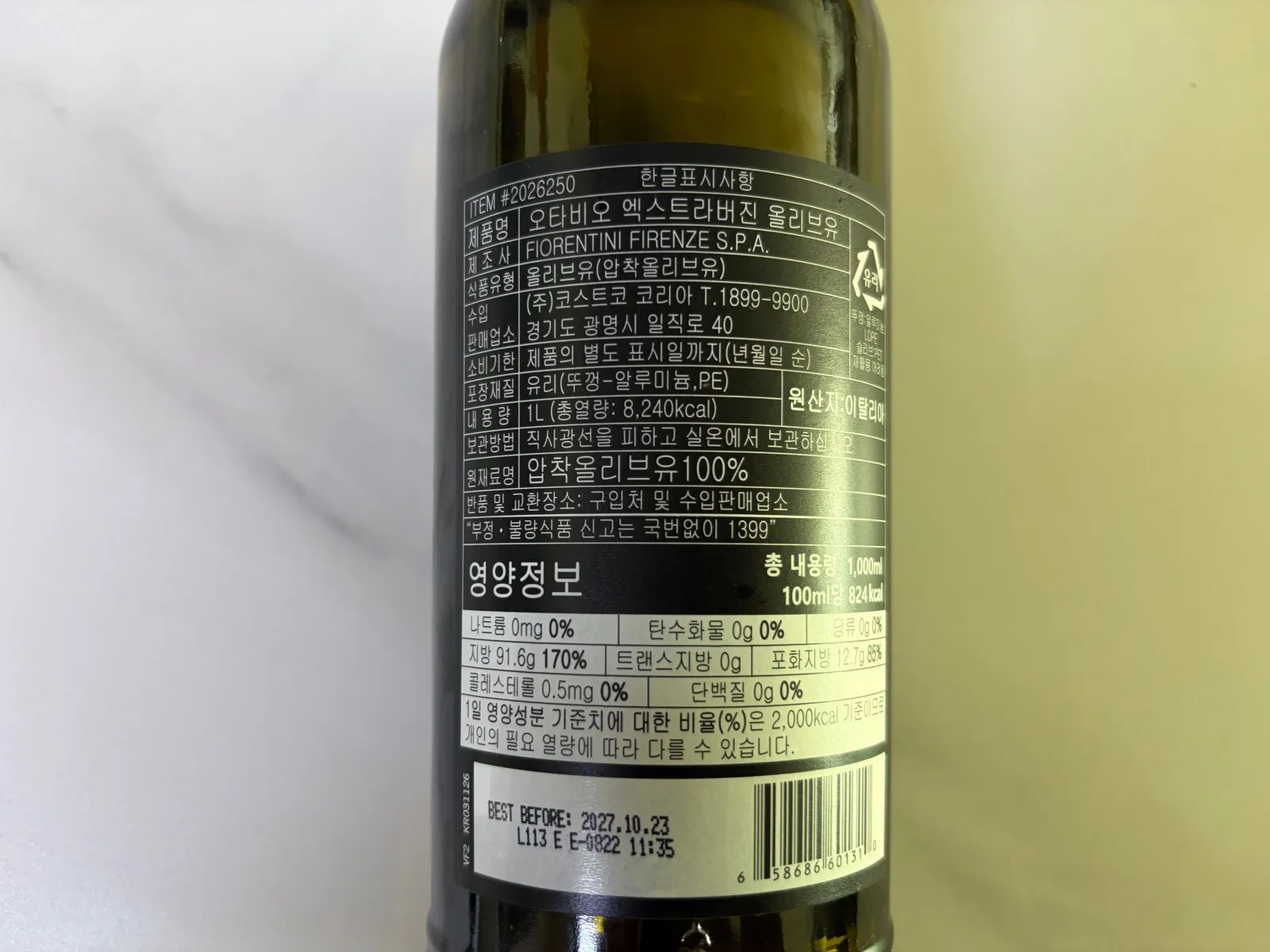
An olive oil label tells you the grade, where the olives were grown, how fresh the oil is and who made it, if you know which line to read. I read every line on the back of the 1 liter bottle in my kitchen, an Ottavio extra virgin olive oil I bought at Costco in Korea, and checked each phrase against the EU, International Olive Council and USDA rules.
Below are the nine lines, what each one means and what my bottle did not say.
The bottle I read
The front of the bottle has five lines: cold pressed, limited reserve, extra virgin olive oil, 100% product of Italy and 1 L net 34 fl oz. The back has a Korean-language import label, with a best before sticker below it.
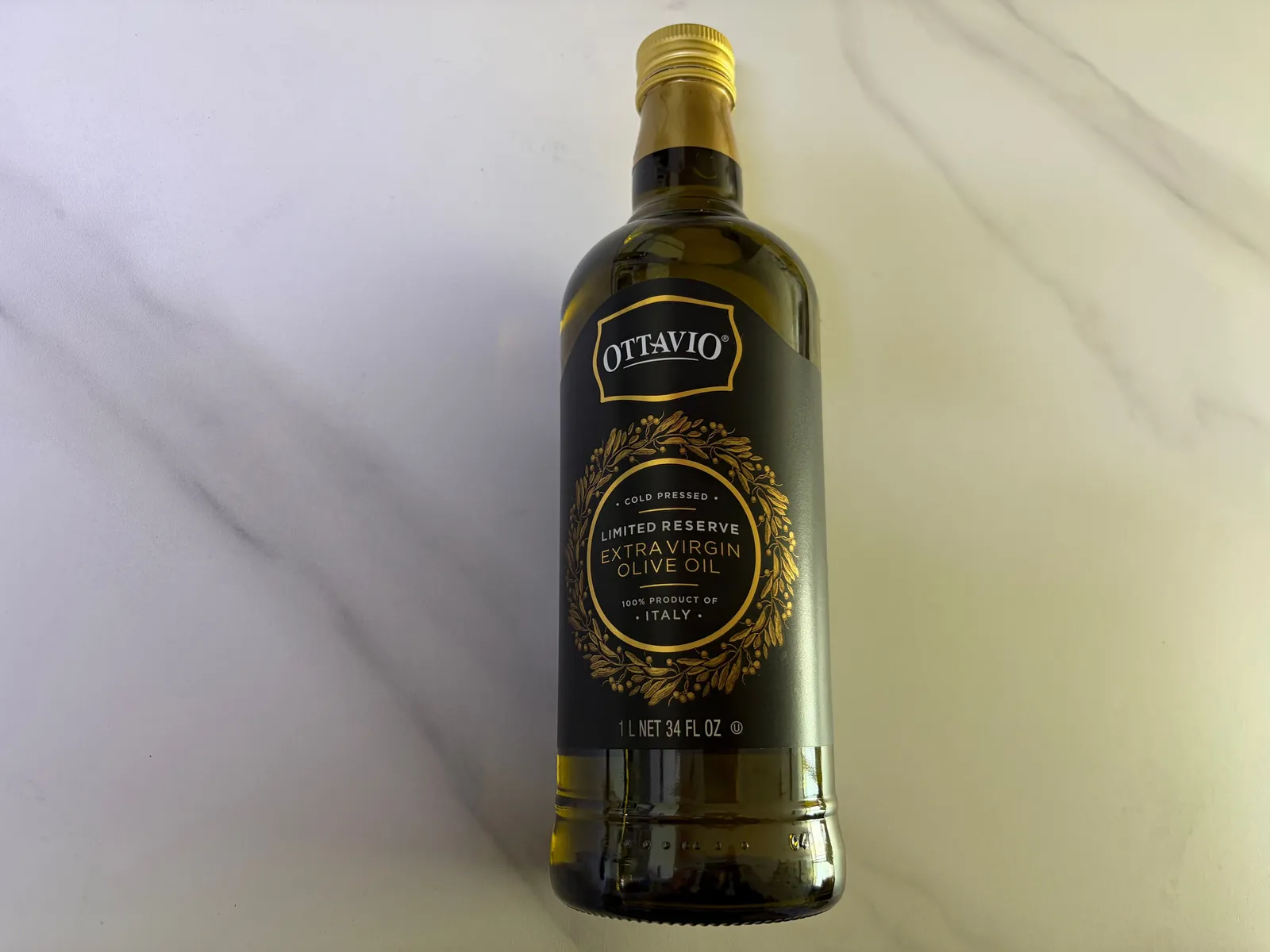
I also had a small 40 ml bottle of Olympias extra virgin olive oil from a trip to Vietnam. Its back label is short, so I use it below only where it shows something the big bottle does not. For what to look for when you buy a bottle, see my guide on how to choose olive oil. This guide is about what the words on the label actually mean.
The 9 label lines at a glance
| Label line | On my bottle | What it tells you |
|---|---|---|
| 1. Grade | Extra virgin olive oil | Unrefined top grade |
| 2. Cold pressed | Cold pressed | Made below 27°C, but true of all extra virgin |
| 3. Brand words | Limited reserve | Not defined in the grading rules |
| 4. Origin | 100% product of Italy | Olives grown and pressed in Italy |
| 5. Producer and importer | Fiorentini Firenze S.p.A., Costco Korea | Who made it and who brought it in |
| 6. Ingredients | Pressed olive oil 100% | No refined oil blended in |
| 7. Best before and lot | 2027.10.23, L113 | Freshness date and batch code |
| 8. Storage | Away from direct sunlight, room temperature | How to keep it |
| 9. Nutrition | 824 kcal per 100 ml | Same as any olive oil |
1. The grade: extra virgin olive oil
The grade is the most important line on the label. Extra virgin olive oil is made from olives by mechanical means only, pressing or centrifuge, with no refining. The International Olive Council trade standard and the USDA grade standard both cap its free acidity at 0.8 grams per 100 grams, measured as oleic acid, and require it to pass a tasting panel with no defects.
A bottle that says only "olive oil" is a blend of mostly refined oil with some virgin oil. My olive oil grades chart lists every grade from extra virgin down to pomace.
2. "Cold pressed": a real rule, but not a difference
The EU sets rules for these words in Delegated Regulation 2022/2104, as summarized by the Food Safety Authority of Ireland. "First cold pressing" may only appear when the oil was made below 27°C from a first mechanical pressing in a traditional hydraulic press. "Cold extraction" means below 27°C by centrifuge or percolation.
The North American Olive Oil Association (NAOOA), an industry group, adds that all extra virgin olive oil comes from the first extraction, and that most oil today is separated by centrifuge rather than by a press. So "cold pressed" on an extra virgin bottle is accurate but does not make it better than another extra virgin oil.
3. "Limited reserve" and other brand words
My bottle says limited reserve right above the grade. I did not find this phrase in the EU, IOC or USDA standards I read. It is the name of the product line, not a grade. Read it the way you would read the brand name, and go back to lines 1 and 4 for facts.
4. Origin: "product of Italy" vs "bottled in Italy"
Origin tells you where the olives were grown and where the oil was made. Extra virgin and virgin olive oil sold in the EU must carry an origin, as the Food Safety Authority of Ireland explains. If the olives were harvested in one country and pressed in another, the label has to say the oil was "obtained in" one "from olives harvested in" the other. A blend from several countries has to say it is a blend.
The NAOOA explains the difference in wording: "product of" a country means the olives were grown and the oil extracted there, while "imported from," "packed in" or "bottled in" only tells you where the oil was shipped from or put into the bottle. My bottle says 100% product of Italy on the front, and the Korean label lists Italy as the country of origin. The two agree.
5. Producer, packer and importer
The producer line tells you who is responsible for the oil. My Costco bottle names Fiorentini Firenze S.p.A. as the manufacturer and Costco Korea as the importer. The small Greek bottle is more specific. It says "produced and packed by" Douzenis Olive Oils in Astros, Arcadia, Greece, and "imported and distributed by" a company in Hanoi.
A line like "produced and packed by" with a company and a town tells you where the oil was bottled as well as who made it. When a label names only an importer or distributor, lean on the origin line in section 4.
6. Ingredients and food type on an imported label
On a single grade of oil, the ingredients line should name only that grade. My Korean label lists the food type as olive oil, with "pressed olive oil" in brackets, and the ingredients as pressed olive oil 100%.
The Korean Food Code, on the Ministry of Food and Drug Safety's Food Safety Korea site, uses one food type, olive oil, for pressed oil, refined oil or a mix of the two. So on a Korean label, check the ingredients line. Pressed olive oil 100% means nothing refined was added. A line listing refined olive oil with a percentage means a blend.
7. Best before date and lot number
The best before date is a freshness date, not a safety cutoff. EU Regulation 1169/2011 defines it as the date until which a food keeps its specific qualities when stored properly. My sticker reads BEST BEFORE 2027.10.23, and the Korean label points to that sticker for the date.
The second line on the sticker, L113 E-0822 11:35, is the lot code. Under EU Directive 2011/91, a lot is a batch made or packed under practically the same conditions, and the code usually starts with L. You will not need it unless something goes wrong with a batch, and then it is how the bottle gets traced.
8. Storage line
The storage line is the producer's own instruction. My Korean label says to keep the bottle away from direct sunlight at room temperature. The small Greek bottle says "Keep in a cool dark place." Both point the same way: a cupboard, not a sunny counter or the shelf next to the stove.
9. Nutrition panel
The nutrition panel on an olive oil bottle is nearly all fat. My label lists, per 100 ml, 824 kcal, 91.6 g fat and 12.7 g saturated fat, with zero carbohydrate, sugar, protein and sodium. That works out to about 124 kcal per tablespoon of 15 ml. The NAOOA notes that all olive oils have the same number of calories, so this panel will not help you compare grades.
What my olive oil label did not say
What a label leaves out is part of reading it. My bottle had no harvest date, no acidity figure, no PDO or PGI mark and no certification seal.
- Harvest date: the date the olives were picked. Not required; my bottle has only a best before date.
- Acidity: EU rules allow it only as the maximum acidity expected by the best before date, printed in the same size next to the peroxide value, wax content and ultraviolet absorption figures.
- PDO or PGI: the European Commission explains that PDO means every stage of production happened in the named region, and PGI means at least one stage did.
- Seals: programs such as NAOOA Certified test bottles taken from store shelves.
None of these were on my bottle, so I read it by grade, origin and best before date. Most of it goes onto food raw: over noodles like my spaghetti stir fry with fish sauce at the table, or shaken into a Korean salad dressing with olive oil.
Questions
What does cold pressed mean on olive oil?
Under EU rules, first cold pressing means the oil was made below 27°C from the first mechanical pressing in a traditional hydraulic press, and cold extraction means below 27°C by centrifuge. The North American Olive Oil Association says all extra virgin olive oil comes from the first extraction, so the words do not set one extra virgin apart from another.
What does product of Italy mean on olive oil?
Product of Italy means the olives were grown and the oil was extracted in Italy, according to the North American Olive Oil Association. Imported from Italy, packed in Italy or bottled in Italy only tells you where the oil was shipped from or put into the bottle. Under EU rules, a blend of oils from several countries has to say it is a blend.
What acidity should extra virgin olive oil have?
Extra virgin olive oil must have a free acidity of no more than 0.8 grams per 100 grams, measured as oleic acid. That is the limit in both the International Olive Council trade standard and the USDA grade standard. Virgin olive oil can go up to 2.0 grams per 100 grams.
What is the L number on an olive oil bottle?
The L number is the lot number. Under EU Directive 2011/91, a lot is a batch made or packed under practically the same conditions, and the code usually starts with the letter L. It lets a producer trace a batch if something goes wrong.
Is the best before date on olive oil an expiry date?
No. Under EU Regulation 1169/2011, a best before date is the date until which a food keeps its specific qualities when stored properly. For olive oil, read it as a freshness date and buy the bottle whose date is furthest away.